
Breast
Breast Reconstruction Revision
Secondary procedures that refine a prior reconstruction — correcting contour, symmetry, implant position, or scarring once the initial reconstruction has healed and settled.


Overview
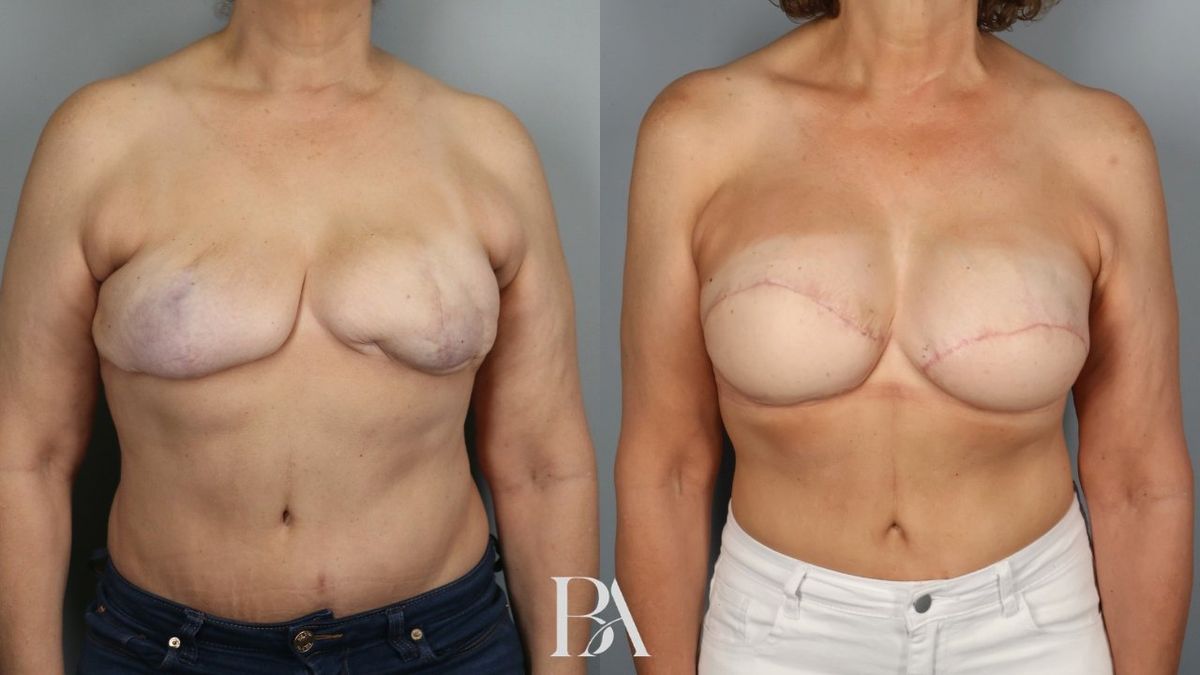
Reconstruction revision addresses the refinements that follow an initial breast reconstruction. Common goals include improving symmetry between the breasts, correcting implant position or rippling, revising scars, adding fat grafting for contour, or adjusting the reconstructed breast to better match the opposite side. Revision is planned once the initial reconstruction has fully healed and settled. The specific steps depend on the starting result and what the patient wants improved.
Who it's for
The right candidate.
Patients who have completed an initial breast reconstruction and want to refine the result — improving symmetry, correcting implant position or rippling, revising scars, or adding contour with fat grafting. Revision is appropriate once the reconstruction has fully healed and settled.
Technique
How it's done.
The approach depends on what is being corrected. Options include capsule adjustment or implant exchange, fat grafting to soften contours or correct rippling, scar revision, and adjustment of the opposite breast for symmetry. Dr. Azadgoli plans the specific steps after the initial reconstruction has settled.
Where this happens
Our own surgery center.
One roof, one team.
Dr. Azadgoli operates at The Practice Healthcare's fully independent, on-property ambulatory surgery center — a Medicare-certified, physician-led facility recognized by Newsweek as one of California's top centers for independent, privately owned surgery.
Consultation, surgery, aftercare, and recovery all happen in one building, with the same team. No outside hospital. No new staff to meet the day of surgery. The same person who checked you in at the consult is there when you wake up.

What to expect
From consultation to recovery.
Most revisions are outpatient with a shorter recovery than the original reconstruction. A compression bra is worn for two to six weeks depending on what was done. Most patients are back to desk work within one to two weeks.

Patient results
Real cases.
Insurance & coverage
Patient Advocacy handles the paperwork.
Our advocacy team verifies benefits, pursues pre-authorizations, and appeals denials. You don't navigate insurance on your own.
Cosmetic procedures are generally not covered by insurance. For reconstructive or medically necessary work, our advocacy team verifies your benefits and presents the out-of-pocket estimate before anything is scheduled.
How we work with insurance
- 1 Verification by expertsOur advocacy team verifies your benefits before any procedure — so we know exactly what is and is not covered.
- 2 Patient advocacy & follow-throughWe aggressively pursue pre-authorizations, appeal denials when appropriate, and hold carriers accountable to their commitments.
- 3 Financial transparencyYou receive a clear written estimate of potential out-of-pocket costs. No surprises on the day of surgery.
- 4 Collaboration with carriersOur team handles documentation and communication directly with your insurance company.
- 5 Options & supportIf a procedure is not covered, we walk you through cash-pay options, financing, and other pathways to care.
FAQ
Common questions.
When can I have a revision?
Once the initial reconstruction has fully healed and settled, usually several months to a year. Operating before the tissue has stabilized makes it harder to judge what needs correcting.
What can revision correct?
Common goals are asymmetry, implant malposition or rippling, firm or distorted capsules, and scar appearance. Fat grafting is often used to soften edges and improve contour.
Is fat grafting part of revision?
Frequently. Fat taken from another area is injected to smooth contour irregularities, cover rippling, and add a natural layer over an implant. It is one of the most useful tools in refining a reconstruction.
Is revision covered by insurance?
Revisions that are part of completing a post-mastectomy reconstruction are covered under the same federal law that covers the original reconstruction. The team confirms coverage before surgery.
How many revisions might I need?
Most patients need one revision, sometimes two for fine-tuning. The goal is to plan thoroughly so the number of operations is minimized.
Can the opposite breast be adjusted for symmetry?
Yes. Surgery on the non-cancer breast to match the reconstructed side — a lift, reduction, or augmentation — is part of achieving symmetry and is covered.
Ready to discuss breast reconstruction revision?
Schedule a consultation with Dr. Azadgoli and her team to explore your options.
Request a consultation